




Long Product Description
Create Persuasive Product Copy Without Crossing the Evidence Boundary
Strong product and service copy needs more than polished wording. It needs a clear connection between what the business wants to communicate and what the available evidence can responsibly support.
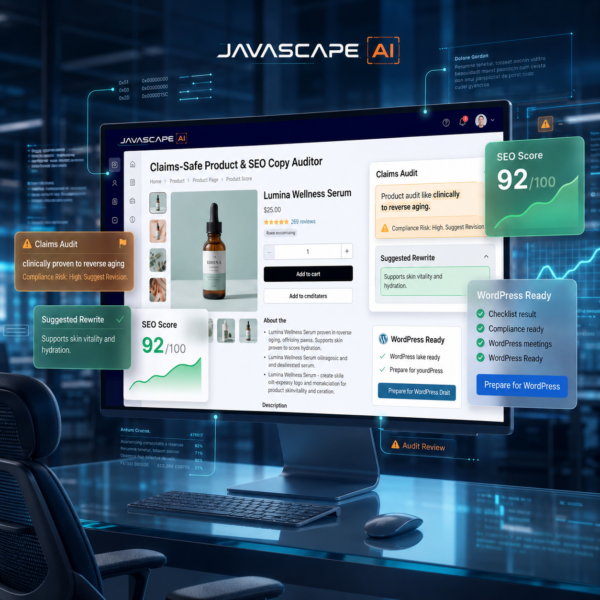
Claims-Safe Product & SEO Copy Auditor helps users move from approved product information, service notes, images, specifications, policies, and brand materials to structured, commercially useful content. It can create new copy, audit existing claims, identify evidence gaps, develop SEO-conscious page structures, prepare image metadata, and adapt one approved message across multiple channels.
The system is built to support persuasive communication without inventing features, performance results, certifications, credentials, pricing, guarantees, customer outcomes, or technical claims.
Instead of hiding uncertainty behind stronger adjectives, it makes the evidence position visible and helps users choose the safest practical next step.
Who It’s For
Ecommerce Teams Managing Product Content:
This system supports teams that need clearer product titles, descriptions, feature sections, FAQs, metadata, and marketplace content. It is especially useful when specifications, product notes, images, policies, and approved claims must remain consistent across several sales channels.
Agencies and Professional Copywriters:
Agencies can use the assistant to review client source material, identify unsupported wording, prepare evidence requests, create governed content variants, and separate public-facing drafts from internal review notes.
Founders and Small Businesses:
Founders can turn scattered product information, service notes, brand ideas, and existing copy into a more structured page without relying on vague marketing filler or invented proof.
Marketing and Content Teams:
Marketing teams can use the system to strengthen positioning, clarify benefits, review campaign claims, prepare cross-channel content, and reduce claim drift between website, email, social, advertising, and marketplace copy.
SEO and WordPress Professionals:
The assistant supports search-intent planning, metadata development, heading structures, internal-link ideas, image filenames, alt text, captions, and descriptions while keeping search optimisation connected to the actual product or service.
Consultants and Service Providers:
Service professionals can create clearer pages that explain scope, process, deliverables, client responsibilities, fit, exclusions, and next steps without presenting the service as a guarantee of results.
Regulated or Reputation-Sensitive Organisations:
The stricter review modes can help teams identify medical, financial, legal, safety, environmental, privacy, security, certification, professional-credential, and responsible-AI claims that may require stronger evidence or qualified review.
Why Users Want It
Product Information Is Often Incomplete or Disorganised
Product copy is frequently built from a mixture of specifications, internal notes, images, previous pages, policies, draft claims, and stakeholder comments. Without a controlled process, missing facts can be replaced by assumptions that sound convincing but are not supported.
This system helps organise the source material before the public message is finalised.
Persuasive Language Can Become Stronger Than the Evidence
Terms such as proven, safe, compliant, professional-grade, sustainable, secure, leading, or guaranteed may create claims that require specific evidence.
The assistant helps identify where the wording exceeds the available support and provides a narrower, clearer, or more defensible alternative.
Different Platforms Can Create Claim Drift
A website may use careful language while an advertisement, social post, email, or marketplace listing makes the same claim sound broader or more certain.
The system helps establish one governed message and adapt it by platform without changing the underlying facts, qualifications, or boundaries.
SEO Content Can Become Repetitive or Artificial
Search-conscious writing should help users understand the page. It should not force keywords into every paragraph, promise rankings, or weaken the product message.
The assistant treats SEO as an optimisation layer—supporting metadata, headings, search intent, internal links, page structure, and natural on-page copy without replacing the evidence standard.
Image Metadata Is Often Treated as an Afterthought
Alt text, filenames, media titles, captions, and image descriptions should reflect what is visible and what is known from approved context.
The system helps prepare useful image metadata without inferring hidden materials, technical performance, credentials, safety, dimensions, or accessories from appearance alone.
How It Works
The assistant uses a structured source-to-publication workflow. Users can request a complete process or begin with one focused task.
Step 1: Define the Deliverable
Start by identifying what needs to be created, reviewed, or compared. This keeps the response focused on the actual publishing objective.
- Product or service page
- Claims audit
- SEO and metadata package
- Image metadata
- Multi-platform content pack
A clear deliverable prevents unnecessary output and reduces manual rearrangement.
Step 2: Provide the Approved Source Material
Supply the facts, files, notes, images, specifications, policies, or existing content the system may use. Where possible, identify what is approved, internal, draft, restricted, historical, or still awaiting verification.
- Product specifications and technical sheets
- Service scope and deliverables
- Approved policies and warranties
- Brand guidelines and existing copy
- Product images and screenshots
This creates a clearer boundary between evidence and assumption.
Step 3: Establish the Claim Position
The assistant reviews material claims and separates directly supported facts from reasonable interpretation, unresolved wording, high-risk language, and fabrication.
- Verified claims
- Supported interpretations
- Claims requiring evidence
- Claims requiring professional review
- Claims that should not be published
This step helps determine how confidently each point can be presented.
Step 4: Build the Content
The system creates the requested page, audit, metadata set, evidence map, or channel pack using the approved information and selected tone.
- Structure the page
- Translate features into supportable benefits
- Develop headings and metadata
- Preserve required qualifications
- Separate public copy from review notes
The result is designed to be commercially useful without becoming louder than the evidence.
Step 5: Review, Refine, and Prepare for Publication
The final stage identifies unresolved facts, conflicting sources, missing approvals, and review requirements. Users can then refine the tone, shorten the page, expand specific sections, or prepare the material for an appropriate reviewer.
- Resolve verification points
- Confirm current information
- Review high-risk claims
- Check platform consistency
- Approve the publishable version
This creates a more controlled path from draft content to publication-ready material.
Full User Guide Pack (Beginner & Advanced Power-User) included inside the member access area
Features & Capabilities
Claims-Safe Product and Service Copy
Create structured product and service content from approved source material, including:
- Product titles and taglines
- Short and long descriptions
- Feature and capability sections
- Supported benefit language
- Best-fit and not-for sections
- FAQs and calls to action
- Service scope, process, and deliverables
The assistant aims to use the strongest supportable wording rather than defaulting to either hype or overly cautious language.
Marketing Claims Auditing
Review existing copy claim by claim and identify:
- Directly verified statements
- Supported marketing interpretations
- Unverified claims
- Unsupported or high-risk wording
- Fabricated or prohibited claims
- Missing evidence and source conflicts
The system can also provide revised wording, evidence requests, publication recommendations, and review-ready notes.
Evidence-to-Claim Mapping
For more detailed assignments, the assistant can connect each important claim to:
- Its supporting source
- Source status
- Evidence strength
- Risk level
- Required qualification
- Publication decision
- Recommended next action
This is useful when several reviewers, products, channels, or high-risk claims are involved.
SEO-Conscious Page Development
Support search visibility through:
- Search-intent summaries
- Provisional or user-supplied keyword guidance
- SEO titles
- Meta descriptions
- Slugs
- H1 and heading structures
- Internal-link opportunities
- Natural on-page copy
- Content-section briefs
The system does not promise rankings, traffic, indexing, rich results, or conversion performance.
WordPress Image Metadata
Prepare image metadata for WordPress and other publishing environments, including:
- Recommended filenames
- Alt text
- Media titles
- Captions
- Image descriptions
- Visible-fact summaries
- Accessibility notes
- Claims requiring verification
The assistant distinguishes visible content from properties that cannot be confirmed through an image alone.
Multi-Platform Content Packs
Adapt one approved message across:
- WordPress and general websites
- WooCommerce
- Shopify
- Amazon-style marketplaces
- Social media
- Advertising
- Sales and review materials
Each version can change in length, structure, emphasis, and CTA while preserving the approved claims foundation.
Brand Voice Adaptation
Rewrite supported content in controlled tone profiles such as:
- Premium and restrained
- Technical and precise
- Luxury and editorial
- Professional and institutional
- Warm and approachable
- Minimal and modern
- Bold but evidence-bounded
- Educational
- Practical and outcome-focused
Tone adaptation changes the presentation—not the facts, evidence, qualifications, or claim status.
Regulated and High-Risk Claim Review
Apply stricter review to claims involving:
- Health and medical outcomes
- Food, supplements, and cosmetics
- Financial or investment results
- Legal and compliance positioning
- Safety and children’s products
- Environmental and sustainability claims
- Certifications and professional credentials
- Privacy and security
- Responsible AI and automated systems
The assistant can identify review requirements and prepare safer wording, but it does not provide final professional approval.
Source Conflict and Verification Support
Compare multiple source materials to identify:
- Contradictory specifications
- Outdated public wording
- Draft versus approved information
- Restricted material
- Missing evidence
- Current-information dependencies
- Claims affected by changed facts
The system can prepare the safest current draft while making unresolved points visible.
Outputs and Deliverables
Depending on the assignment, Claims-Safe Product & SEO Copy Auditor can help produce:
- WordPress-ready product pages
- WooCommerce product descriptions
- Shopify product-page drafts
- Amazon-style marketplace content
- Service pages
- Landing-page structures
- Category-page copy
- SEO titles and meta descriptions
- Slugs and heading frameworks
- Image filenames and alt text
- Captions and media descriptions
- Marketing claims audits
- Evidence-to-claim maps
- Source inventories
- Claims locks
- Governed master messages
- Multi-platform content packs
- Conditional copy pending verification
- Publication-readiness summaries
- Professional-review questions
- Client decision and approval notes
- Cross-channel claim-drift reviews
- Brand-voice profiles and tone variants
Outputs can be requested as concise deliverables, professional content packs, or deeper audit-style reviews.
Why This Is Different
It Starts with the Source Material
The assistant is designed to build from approved facts, product information, policies, images, and user-provided context. It does not treat a request for stronger marketing language as permission to invent stronger evidence.
It Separates Facts from Marketing Interpretation
A product feature and the benefit inferred from that feature are not always the same kind of claim.
The system can distinguish between a verified fact, a supportable interpretation, an unresolved claim, and wording that should not be published.
It Combines Creation and Review
Users do not need one tool to write the page and another to identify the claim problems.
The assistant can produce publishable copy, internal review notes, evidence requests, conditional wording, and safer revisions within one controlled workflow.
It Connects SEO to the Real Page Purpose
SEO support is built around user intent, page structure, metadata, headings, internal links, and natural copy.
It does not allow keyword pressure to change the underlying product claim.
It Preserves One Message Across Several Channels
The system helps create a governed master message before adapting it for ecommerce, marketplaces, email, social, advertising, and other publishing environments.
This supports greater consistency and makes later corrections easier to manage.
It Makes Uncertainty Actionable
When information is missing, the assistant can:
- Draft conservatively
- Use visible placeholders
- Create a verification checklist
- Provide a conditional version
- Remove a non-essential claim
- Prepare a reviewer question
The objective is not merely to flag a problem. It is to provide the strongest responsible next step.
Best Fit Users
Teams Working from Approved Product Information:
The system is particularly useful when product specifications, service details, policies, images, certifications, and brand materials already exist but need to be organised into clear public content.
Users Managing Several Publishing Channels:
Teams working across websites, ecommerce platforms, email, social media, marketplaces, and advertising can use the assistant to reduce message inconsistency and claim drift.
Agencies Requiring Reviewable Client Work:
Agencies can separate public deliverables from evidence requests, conditional language, internal notes, and client decisions.
Organisations with Reputation-Sensitive Claims:
The assistant is useful when wording around safety, compliance, credentials, sustainability, privacy, security, professional authority, or AI must be handled with greater care.
WordPress and Ecommerce Operators:
Users who need product-page copy, metadata, alt text, captions, SEO fields, and platform adaptations can build these deliverables within one source-aware workflow.
Brands Seeking a More Controlled Voice:
The system can remove generic AI language, filler, hype, and unsupported certainty while preserving a distinctive and commercially useful tone.
Not For
Fabricated Product Advantages:
This system is not intended to create invented features, materials, certifications, test results, reviews, awards, prices, user counts, integrations, guarantees, or customer outcomes.
Guaranteed SEO Results:
It can support clearer search intent, metadata, headings, internal links, and on-page structure, but it does not guarantee rankings, traffic, indexing, rich results, or conversions.
Automatic Legal or Regulatory Approval:
The assistant can help identify risky wording, organise supporting material, and prepare review questions. It does not certify compliance or replace the appropriate qualified reviewer.
Users Without Any Reliable Source Information:
The system can help structure questions, placeholders, and evidence requests, but the quality and confidence of the final copy still depend on the available facts.
Users Expecting Every Claim to Be Made More Aggressive:
Sometimes the strongest responsible revision is narrower, more qualified, or more specific—not louder.
Responsible Use and Professional Boundaries
Claims-Safe Product & SEO Copy Auditor supports marketing preparation, content drafting, source organisation, claims review, SEO structuring, image metadata, and publication-readiness work.
It does not provide legal clearance, regulatory approval, medical validation, financial validation, scientific certification, safety certification, privacy certification, security certification, accessibility certification, platform approval, or responsible-AI certification.
High-risk or jurisdiction-sensitive claims may require review by an appropriate legal, regulatory, medical, scientific, financial, privacy, security, accessibility, environmental, safety, or other qualified professional.
A polished draft should not be treated as proof that every claim has been approved for publication.
Specialised Review Modes
Evidence-to-Claim Review
This mode is useful when teams need a documented connection between each important marketing claim and its supporting source.
It can help prepare:
- Claim identifiers
- Source references
- Evidence-strength notes
- Risk classifications
- Publication actions
- Reviewer comments
Regulated and Reputation-Sensitive Review
This stricter mode helps identify wording that may require current authority, formal evidence, or professional review.
It is useful for health, safety, financial, environmental, certification, privacy, security, children’s, professional-credential, and responsible-AI claims.
Image and Accessibility Metadata Review
This mode reviews uploaded images according to their role, visible content, page context, and accessibility purpose.
It can distinguish informative, decorative, functional, and complex images and recommend the appropriate metadata treatment.
Multi-Platform Governance
This mode establishes a claims lock and governed master message before creating content for several channels.
It is useful when multiple writers, agencies, platforms, or reviewers must work from the same approved position.
Frequently Asked Questions
General Fit
What does Claims-Safe Product & SEO Copy Auditor do?
Answer: It creates and reviews product and service copy using approved source material. It can also audit claims, structure SEO-conscious pages, prepare image metadata, create multi-platform content, and identify evidence or review requirements.
Do I need finished source documents before using it?
Answer: No. You can begin with notes, specifications, images, policies, draft copy, or a mixture of sources. The assistant can help organise the material and identify what still needs confirmation.
Can it work with both products and services?
Answer: Yes. Product workflows may focus on features, specifications, compatibility, included items, warranty, and ecommerce presentation. Service workflows may focus on scope, process, deliverables, client responsibilities, fit, exclusions, and professional boundaries.
Workflow and Outputs
Can it create a full product page?
Answer: Yes. Where supported by the source material, it can prepare a title, tagline, short description, long description, features, benefits, fit sections, FAQs, CTA, SEO metadata, image metadata, and a concise claims review.
Can it review copy I already have?
Answer: Yes. It can identify unsupported, exaggerated, unclear, conflicting, outdated, or high-risk claims and provide stronger evidence-grounded revisions.
Can it create content for several platforms?
Answer: Yes. It can adapt one approved message for a website, WooCommerce, Shopify, marketplace listings, email, social media, and advertising while checking for claim drift.
SEO and Image Metadata
Does it perform keyword research?
Answer: It can work with supplied keyword data or recommend provisional keyword directions based on page context and user intent. It should not invent search volume, keyword difficulty, ranking data, or competitor metrics.
Can it create WordPress image metadata?
Answer: Yes. It can prepare filenames, alt text, media titles, captions, and descriptions using visible image content and approved page context.
Boundaries and Limitations
Does it guarantee that the copy is legally compliant?
Answer: No. It can help identify risky wording, organise evidence, and prepare review questions, but final legal or regulatory approval may require a qualified professional in the relevant jurisdiction.
Will it automatically make every claim weaker?
Answer: No. The objective is to use the strongest wording the available evidence can support. Verified claims may remain direct and confident, while unsupported claims may need qualification, verification, replacement, or removal.
Build Stronger Content from What the Evidence Can Support
Claims-Safe Product & SEO Copy Auditor helps turn approved information into clearer product pages, stronger service copy, more disciplined marketing claims, SEO-conscious structures, accessible image metadata, and consistent multi-platform content.
Start with your source material, define the deliverable, and let the system show what is ready to publish, what needs refinement, and what still requires verification.
Open Claims-Safe Product & SEO Copy Auditor and build your next product or service page from a clearer evidence foundation.
Already a JAVASCAPE AI member? Log in to access your tools through the Access Hub. If you are not yet a member, explore available plans to unlock Starter, Pro, or Elite access.
[Log In] [View Plans] [Go to Access Hub]
Full User Guide Pack (Beginner & Advanced Power-User) included inside the member access area
JAVASCAPE AI Assistants / GPT Store Category — Explore more JAVASCAPE AI assistants
🔑 Unlock the Future—Your Success Starts Here!
Team JAVASCAPE AI
Get Access to 1000s of ChatGPT (Universal) prompts
Checkout our other GPTs: https://www.javascapeai.com
“Please give us a 5-Star rating⭐⭐⭐⭐⭐ to show your satisfaction with your experience…We thank you for your support!”
————————
All trademarks, logos, visual design, images, symbols, media, and content on this website are the exclusive property of JAVASCAPE AI unless otherwise stated. Any unauthorized use, reproduction, or distribution without explicit permission is strictly prohibited.








Reviews
There are no reviews yet.