ChatGPT: Search, GPT-5, Atlas & Pulse vs Google: AI Mode, AI Overviews & Gemini Live
By Jaron Jackson – Senior Editor • Updated October 30, 2025
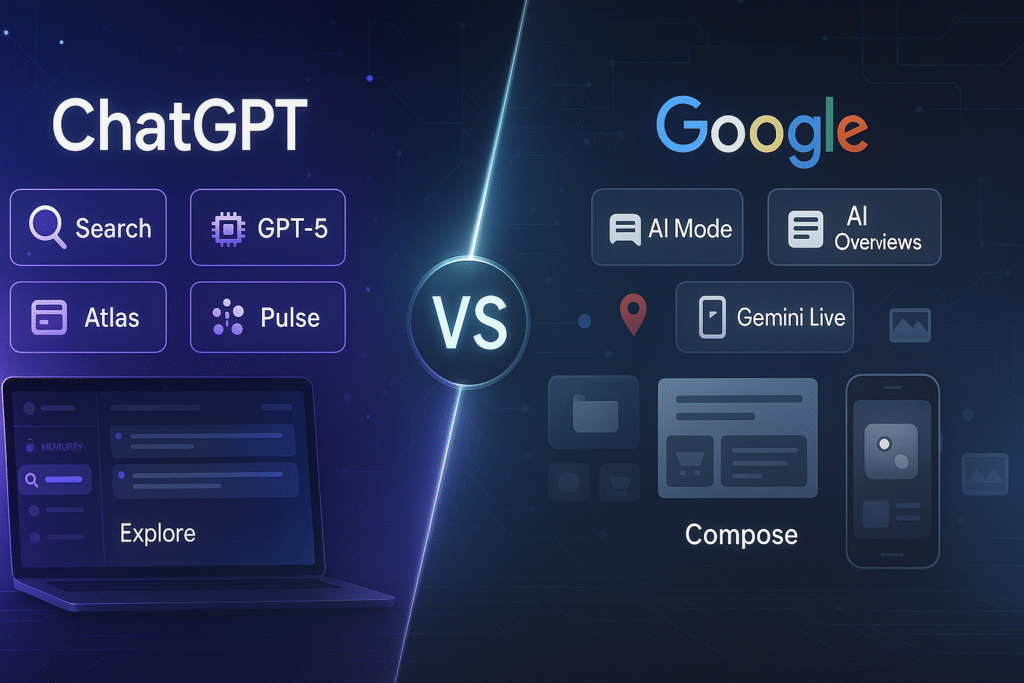
In 2025, the web no longer begins and ends with “10 blue links.” Instead, answers often arrive as full paragraphs—with sources, examples, and even follow-up questions you didn’t know to ask. Two ecosystems, in particular, are shaping that shift. On one side, ChatGPT offers ChatGPT Search for timely, linked answers, the GPT-5 model for stronger reasoning and coding, Atlas (a browser with ChatGPT built in), and Pulse (daily, proactive research). On the other, Google Search remains the world’s primary gateway to the open web, reinforced by AI Overviews, AI Mode for conversational follow-ups, and Gemini Live for camera/screen-share help. (OpenAI)
Although headlines sometimes frame this as a zero-sum showdown, reality is more practical. ChatGPT is exceptional at reasoning through problems, drafting and refining content, and carrying context over many turns. Meanwhile, Google is unmatched at surfacing the breadth of the live web—images, maps, local results, shopping, and news—while increasingly summarizing those results with AI. Consequently, the “right” choice depends on your task, your time pressure, and whether you prefer open-ended exploration or a guided conversation.
60-second checklist: use Google for live/local pivots; switch to ChatGPT for synthesis and drafting; finally, cross-check key claims by opening the cited links.
Quick nav: Table of Contents • References
Table of Contents (Clickable Navigation):
- What Exactly Are We Comparing?
- What’s New in 2025 (At a Glance)
2.1 ChatGPT: Search, GPT-5, Atlas & Pulse
2.2 Google: AI Mode, AI Overviews & Gemini Live - How They Work (High-Level)
3.1 ChatGPT: Generative Reasoning + Live Retrieval
3.2 Google: Crawl → Index → Rank → Summarize - Strengths, Limits, and When to Use Each
4.1 Beginners: Everyday Tasks
4.2 Intermediate: Research, Planning, Writing
4.3 Advanced: Accuracy, Traceability, Scale - Meet Your Intent Fast: A 4-Step Flow
- Comparison Charts
6.1 Task-Fit Matrix
6.2 Feature-by-Feature Comparison - Practical Workflows (Non-SEO)
- Examples & Mini Case Insight
- Privacy, Personalization, and Pricing
- Outlook: Where This Is Headed Next
- Final Take & Conclusion
- FAQs
- References (Consolidated)
1) What Exactly Are We Comparing?
We’re comparing two overlapping—but distinct—systems. ChatGPT is a conversational assistant that generates and explains text, code, plans, and summaries, now with Search for timely, linked answers; Atlas for browser-native help; and Pulse for proactive updates. Google Search, by contrast, is a discovery engine designed to map the live web; AI Overviews and AI Mode now add conversational synthesis on top while preserving classic results—Images, Maps, Shopping, and News. (OpenAI)
2) What’s New in 2025 (At a Glance)
The past year accelerated both ecosystems. Notably, ChatGPT gained deeper reasoning and proactive briefings, whereas Google broadened its conversational search and live assistance. Therefore, users can mix and match depending on the moment.https://openai.com/index/introducing-
2.1 ChatGPT: Search, GPT-5, Atlas & Pulse
- ChatGPT Search is broadly available and returns timely answers with linked sources directly in the chat. (OpenAI)
- GPT-5 significantly boosts multi-step reasoning, coding, and long-form writing. (OpenAI)
- Atlas brings ChatGPT into your browser so you can ask in context while you read, compare, and act. (OpenAI)
- Pulse delivers daily, personalized research snapshots you can verify via links. (OpenAI)
Back to top • References
2.2 Google: AI Mode, AI Overviews & Gemini Live
- AI Overviews summarize results at the top of the SERP with supporting links and have expanded globally. (blog.google)
- AI Mode enables longer, conversational follow-ups without leaving Search, and it continues to roll out in more regions and languages. (blog.google)
- Gemini Live lets you point your camera or share your screen for step-by-step help on mobile. (blog.google)
Back to top • References
3) How They Work (High-Level)
At a high level, both systems blend generative AI with the web, yet they start from different ends. ChatGPT begins with a conversational model that can retrieve live information; Google begins with a live index that now layers in conversational summaries. Consequently, the user experience converges in some moments but diverges in others.
Back to top • References
3.1 ChatGPT: Generative Reasoning + Live Retrieval
ChatGPT generates answers with a modern large-language model (GPT-5) and, when needed, retrieves current information with Search—returning linked sources you can open and inspect. With Atlas, that same reasoning sits inside your browser; with Pulse, you receive a steady stream of updates to review and confirm. (OpenAI+2arXiv+2)
Back to top • References
3.2 Google: Crawl → Index → Rank → Summarize
Google continuously crawls the web, indexes pages, and ranks results using many signals. AI Overviews and AI Mode then layer generative summaries on top of that index, letting you jump to links, Maps, products, or local businesses. Thus, broad discovery is preserved yet presented more conversationally when you want it. (Google for Developers+2Google for Developers+2)
Back to top • References
4) Strengths, Limits, and When to Use Each
Because no AI is perfect, linked sources and cross-verification remain essential. Even so, each system shines in different moments; therefore, choose based on intent.
Back to top • References
4.1 Beginners: Everyday Tasks
If you need a friendly explanation, a recipe tweak, or a polite email, ChatGPT excels at tone, rewriting, and iteration—while citing when asked. Conversely, if you’re choosing a restaurant, checking hours, or seeing what’s trending, Google is still the fastest route to images, maps, ratings, busy times, and news—with an AI Overview on top. (OpenAI)
Back to top • References
4.2 Intermediate: Research, Planning, Writing
For research, Google is built for breadth: scan headlines, open tabs, pivot to Images/News, and save references. Meanwhile, ChatGPT is built for synthesis: compare viewpoints, outline your plan, and turn notes into a clear draft—then iterate with citations. In practice, many users collect diverse sources with Google and then summarize and draft with ChatGPT. (blog.google)
Back to top • References
4.3 Advanced: Accuracy, Traceability, Scale
For complex multi-step reasoning (e.g., refactoring code, simulating user journeys, or structuring intricate plans), ChatGPT often feels more agent-like—especially with GPT-5. For rapid pivots across modalities (Maps, Shopping, Flights, Video, camera), Google still wins on speed and coverage—particularly when Gemini Live or AI Mode can “see” your context. (OpenAI)
Back to top • References
5) Meet Your Intent Fast: A 4-Step Flow
- Define the outcome: Do you need a plan (start in ChatGPT) or a live/local fact (start in Google)?
- Start where each shines: Ask Google AI Mode a complex question and scan the AI Overview + links; or request a multi-source synthesis in ChatGPT Search with opposing views and a simple verification checklist. (blog.google)
- Cross-check: Open 2–3 citations; confirm date, author, and evidence.
- Capture & iterate: In Atlas, save pages to a “knowledge trail,” then ask ChatGPT to reconcile differences; finally, let Pulse keep you current, and verify anything material via linked sources. (OpenAI)
Back to top • References
6) Comparison Charts
These charts summarize typical fit-for-purpose choices. They are not exhaustive; nevertheless, they cover the majority of everyday and professional tasks.
Back to top • References
6.1 Task-Fit Matrix
| Task Type | Best First Pick | Why | Follow With |
|---|---|---|---|
| Local & live info | Google AI Mode | Maps, inventory, hours, real-time pivots | ChatGPT for itinerary/options |
| Deep research & synthesis | ChatGPT Search | Multi-source summaries + context | Google to validate freshness |
| Product comparisons | Either | Both cite sources; evaluate link depth | Open top links to verify |
| Coding / creative | ChatGPT (GPT-5) | Iterative reasoning, refactoring, tone | Google for docs/issues |
| Troubleshooting on mobile | Gemini Live | Camera/screen-share guidance | Atlas to store steps and summarize |
(Rationale sources: platform feature pages and product blogs.) (OpenAI)
Back to top • References
6.2 Feature-by-Feature Comparison
| Capability | ChatGPT (Search / GPT-5 / Atlas / Pulse) | Google (AI Mode / AI Overviews / Gemini Live) |
|---|---|---|
| Conversational memory | Strong; persistent context and style control | Improving; follow-ups within AI Mode |
| Citations in-line | Yes; linked sources in chat | Yes; links beside summaries & classic results |
| Local intent | Adequate; relies on retrieved sources | Excellent; Maps, hours, inventory, reviews |
| Live troubleshooting | Good in Atlas with page context | Strong via Gemini Live (camera/screen-share) |
| Rapid modality pivots | Good; needs browsing hand-offs | Excellent; Maps/Shopping/Flights/News |
| Drafting & rewriting | Outstanding; step-by-step iteration | Solid; better for discovery + docs |
| Proactive updates | Pulse briefs (verify via links) | SERP & app features; Discover/Alerts |
| Typical access | Free; Plus/Pro tiers available | Search free; AI plans (Pro/Ultra) available |
(Feature references: product announcements and support pages.) (OpenAI)
Back to top • References
7) Practical Workflows
- Explore with Google, compose with ChatGPT. Gather diverse links and local context in AI Mode; then paste highlights into ChatGPT and ask for an outline, a decision matrix, or a plain-language summary with citations. (blog.google)
- Draft in ChatGPT, validate with Google. After ChatGPT drafts an email, memo, or plan, run a quick Google pass to confirm names, dates, and statistics before you act. (OpenAI)
- Use mobile features when context matters. If you’re troubleshooting IRL, Gemini Live can walk you through steps while you show what you’re seeing; afterward, have Atlas store the steps and convert them into a reusable checklist. (blog.google)
Back to top • References
8) Examples & Mini Case Insight
Weekend city plan (local + exploratory):
Google first: “Best kid-friendly museums near me this Saturday,” then switch to AI Mode and confirm hours/tickets. Next, ask ChatGPT to blend the options into a 6-hour itinerary with transit times, snack stops, and a rain backup, with sources listed. Finally, save the pages in Atlas and let Pulse flag weather shifts the morning of—then verify via links. (blog.google)
Back to top • References
9) Privacy, Personalization, and Pricing
Privacy & personalization: ChatGPT primarily adapts to your instructions, memory settings, and feature choices (e.g., Pulse/Atlas privacy controls). Google leans on account history, location, device signals, and activity across its ecosystem, while AI Mode continues to ship to more locales. (OpenAI Help Center)
Pricing (typical in 2025): ChatGPT has Free, Plus (~$20/mo), and Pro tiers; Google offers Search free and paid AI plans (e.g., AI Pro/Ultra) for advanced Gemini features. Regional prices vary; therefore, always check the latest plan pages. (ChatGPT)
Back to top • References
10) Outlook: Where This Is Headed Next
The split between exploration (Google) and reasoned creation (ChatGPT) is becoming more complementary than competitive. Expect AI Overviews to deepen across countries and tasks, while AI Mode experiments with richer reasoning in the search box. Conversely, GPT-5 plus Search, Atlas, and Pulse will keep making drafting, coding, and multi-step planning feel less like “using a tool” and more like collaborating with an expert. In short, specialization—not replacement—is the story. (blog.google)
Back to top • References
11) Final Take & Conclusion
Replacing Google outright isn’t the real story; the story is how people now blend tools to get better results. Google remains the fastest way to discover what’s out there at web scale—images, local places, shopping listings, maps, breaking news, and deep indexes—now layered with AI Overviews and an optional AI Mode so you can keep asking follow-ups without losing the breadth of the open web. Meanwhile, ChatGPT has become a reliable partner for reasoned creation—planning, drafting, rewriting, and refactoring ideas or code—especially when live citations are pulled into the conversation to keep you grounded.
As these systems evolve, their strengths are becoming more complementary than competitive. Google doubles down on coverage, context, and speed, helping you pivot instantly from a headline to a map, from a product to a review, or from a definition to primary sources. Conversely, ChatGPT pushes depth, coherence, and iteration, turning scattered notes into clean prose, converting requirements into working code, or walking you through a decision step by step. In practice, you explore widely with Google and then refine confidently with ChatGPT—the open sky of the web, plus a pilot who can explain every instrument on the dashboard.
Consequently, the “winner” isn’t a single platform, but whichever tool fits the task in front of you. If the goal is rapid discovery and comparison, start with Google. If the goal is structured thinking, nuanced explanations, or polished output, start with ChatGPT. Most days, you’ll use both in sequence: scout with Google, synthesize with ChatGPT, then loop back to verify sources and fill any gaps. That hybrid workflow is where real productivity—and better answers—are found.
11) FAQs
Q1: Is ChatGPT replacing Google?
No. They serve different intents at different scales. Use Google for live/local breadth and quick pivots; choose ChatGPT for multi-step reasoning, synthesis, and iterative drafting.
Q2: What is Google’s AI Mode?
A conversational layer inside Search (powered by Gemini) that supports follow-ups and longer sessions, while still letting you jump to classic results, Maps, or Shopping. (blog.google)
Q3: What is ChatGPT Search—and is it current?
ChatGPT Search provides sourced, timely answers from the web, available broadly in ChatGPT with linked citations you can open. (OpenAI)
Q4: What are Atlas and Pulse?
Atlas is a browser with ChatGPT built in for context-rich browsing; Pulse delivers daily, proactive research snapshots. (OpenAI)
Back to top • References
12) References (Consolidated)
- OpenAI — ChatGPT Search announcement; GPT-5 overview; Pulse announcement & release notes; Atlas product page & download. (OpenAI)
- Google — AI Overviews global expansion; AI Mode product posts & support pages; Gemini Live updates. (blog.google)
- Background — How Google Search evolves toward conversational answers (product blogs and support). (blog.google)
Direct link to this article: Jump to Top
All trademarks, logos, visual design, images, symbols, and content on this website are the exclusive property of JAVASCAPE AI. Any unauthorized use, reproduction, or distribution without explicit permission is strictly prohibited.