
How we think about bias, “wokeness,” uncensored models — and what actually matters when real businesses depend on AI.
Summary
A viral debate on X claims investors and power users are abandoning ChatGPT for Grok and Gemini, citing “wokeness,” safety filters, and bias. At JAVASCAPE AI, we watch that debate closely—but we don’t treat it like a popularity poll. We test Grok, Gemini, Claude and others constantly, yet we still run our core solutions on ChatGPT, because for serious, production-grade use we care most about reliability, governance, and outcomes—not vibes. This article explains how the big models differ, why people feel so strongly about them, how we handle bias and safety in our work, and how to choose the right tool for the job instead of joining an AI fan club.
Table of Contents
- Introduction: Beyond the AI Tribal Wars
- What the Viral Conversation on X Is Really About
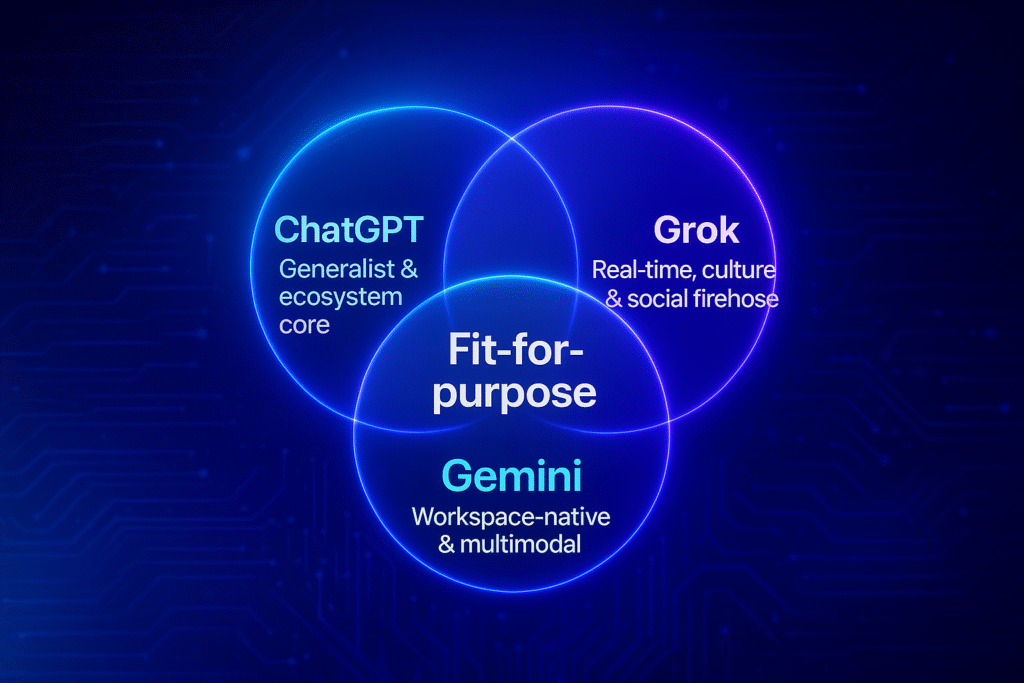
- How ChatGPT, Grok, and Gemini Actually Differ
- Why JAVASCAPE AI Still Chooses ChatGPT as Our Core
- Bias, “Wokeness,” and Safety: How We Think About It
- From “Which Bot Is Best?” to “What Are You Building?”
- How JAVASCAPE AI Uses This Moment—Not Just Reacts to It
- How to Join the Conversation as a Business Leader
- Conclusion
- References
1. Introduction: Beyond the AI Tribal Wars
Every few months, the AI world finds a new “main character.”
Today, it’s a viral X thread with millions of views where users say they’ve ditched ChatGPT for Grok and Gemini. Some praise Grok for being funnier and less filtered. Others claim Gemini is a productivity powerhouse with better privacy. A vocal crowd insists ChatGPT is “too safe,” “too polite,” or “too politically correct.”
At JAVASCAPE AI, we pay attention to these conversations—but we don’t treat them like a console war.
We treat them as signals:
- Signals about what real users are frustrated by
- Signals about where each model currently shines
- Signals about where the next wave of innovation needs to happen
Most importantly: we are heavily invested in OpenAI and ChatGPT as our core platform—and we choose that deliberately, not blindly. We use and test Grok, Gemini, Claude and others every day. Our job is not to be fans; it’s to build systems our clients can trust.
Our philosophy in one line:
Fit-for-purpose, not fanboyism.
2. What the Viral Conversation on X Is Really About
If you strip away the memes and hot takes, that X thread boils down to a few recurring themes:
- “ChatGPT is too safe, too agreeable, too ‘polite’ about controversial topics.”
- “Grok feels more human, funny, and less corporate-filtered.”
- “Gemini is becoming the productivity workhorse—especially inside Google Workspace.”
- Many power users now rotate between ChatGPT, Grok, Claude, Gemini, Perplexity, and others depending on the job.
Underneath all of that is a deeper clash of values and expectations:
- Some people want maximum freedom and minimal guardrails.
- Others want maximum safety, consistency, and brand protection.
- Most want both, depending on whether they’re brainstorming memes or drafting a board-ready memo.
People aren’t just choosing an AI.
They’re choosing a philosophy of how AI should behave.
Here’s a real-world snapshot of how power users are already rethinking their AI stack. In a recent post on X (formerly Twitter), tech investor Pierre Ferragu shared that he cancelled his ChatGPT Pro subscription and now relies on Gemini and Grok instead. Elon Musk’s one-word reply — “Interesting” — captures how quickly sentiment can shift as new models compete for the same spot in your workflow.
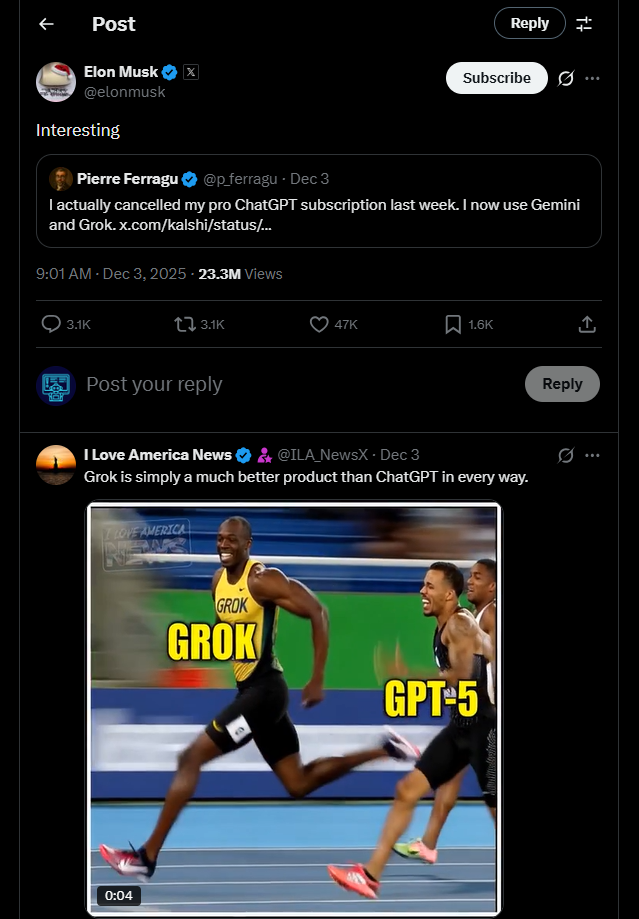
https://x.com/elonmusk/status/1996218137692483941
3. How ChatGPT, Grok, and Gemini Actually Differ
Let’s step away from the commentary and look at what these systems actually are, using public information and real-world usage.
3.1 ChatGPT – The Generalist Workhorse
ChatGPT, built by OpenAI, is still the world’s most widely adopted general-purpose AI assistant.
What it’s good at:
- Strong all-round performance in writing, coding, analysis, and reasoning
- Wide ecosystem: APIs, tools, plugins, and integrations used by startups up to Fortune 500 enterprises
- Enterprise offerings with SOC 2 compliance, encryption in transit and at rest, SSO, admin consoles, and strict policies around business data use.OpenAI+1
OpenAI’s enterprise stack is designed so that:
- Customer data isn’t used for training in enterprise plans
- Data is encrypted and access is tightly controlled
- Organizations get telemetry, access control, and governance tools tuned for large-scale rolloutsOpenAI+1
Trade-off:
ChatGPT often refuses or softens responses around sensitive topics—politics, hate speech, explicit content, misinformation. Some users perceive this as “bias”; others (especially regulated industries) see it as professionalism and risk management.
For businesses, that “safe by default” posture is often a feature, not a bug.
3.2 Grok – Real-Time, Edgy, X-Native
Grok, developed by Elon Musk’s company xAI, was designed explicitly to feel less “corporate” and more like a witty, opinionated guide to the live internet.Wikipedia+1
Key traits:
- Real-time access to X (formerly Twitter) and the web, designed for current events, trends, and social chatter
- A “bold” or “rebellious” tone—early versions even marketed an “edgy” fun mode
- Newer Grok models (like Grok-3 and beyond) emphasize stronger reasoning and faster responses, especially for heavy use casesWikipedia+1
This makes Grok particularly interesting for:
- Following real-time market or culture signals
- Summarizing fast-moving conversations and controversies
- Adding a more human, sometimes sarcastic style to answers
Trade-off:
Because Grok leans heavily on X’s chaotic data firehose and intentionally relaxed tone, it can express strong opinions, edgy humor, and internet-flavored bias much more easily than something like ChatGPT. That can be fun and engaging—but it demands more critical thinking and fact-checking from the user.
3.3 Gemini – Workspace-Native & Multimodal
Gemini is Google’s flagship model family and AI assistant, deeply integrated across Google Workspace—Gmail, Docs, Sheets, Slides, Drive, and more.Google Workspace+1
What makes Gemini distinctive:
- Built as a multimodal model: can work with text, code, images, and other media types in one systemblog.google+1
- Gemini appears directly as a side panel in Workspace apps, so you can summarize long email threads, analyze spreadsheets, draft documents, or create slide outlines without leaving the appGoogle Workspace+1
- Newer releases like Gemini 3 push harder on advanced reasoning and agentic behavior while staying inside the Workspace ecosystem, and tools like Workspace Studio let teams build embedded AI agents to automate workflows.The Times of India+1
For teams already living in Google Workspace, Gemini naturally becomes the productivity co-pilot.
Trade-off:
Gemini is extremely compelling for internal productivity, but its “voice” and creative breadth can feel less distinct than Grok’s personality or ChatGPT’s conversational style. And as with any deeply embedded assistant, integration can create new security and phishing risks (for example, prompt-injection attacks inside email summaries), which organizations need to mitigate.TechRadar
4. Why JAVASCAPE AI Still Chooses ChatGPT as Our Core
We do not ignore Grok or Gemini. We test them all the time. We understand why users like them, and we are excited about the competition.
But at JAVASCAPE AI, we still choose OpenAI’s ChatGPT as our primary foundation, especially for systems that touch real customers, revenue, and risk.
Here’s why.
4.1 Our Criteria for a Core AI Platform
When we pick a foundation model for client solutions, we care about:
- Reliability & Consistency
- When an AI is helping draft customer emails, generate legal-adjacent text, or power a support agent, we value predictable behavior over edgy responses.
- Ecosystem & Tooling
- OpenAI offers mature APIs, evaluation tools, usage analytics, and supporting infrastructure that make it easier to build, monitor, and iterate on production systems.
- Governance & Safety Controls
- Enterprise-level features like SSO, access logging, SOC 2 compliance, and clear enterprise privacy commitments matter when you’re deploying across a whole organization.OpenAI+1
- Performance Across Domains
- We need a model that performs well at code, content, analysis, and reasoning—not just one of those.
- Enterprise Readiness
- We look for clear data-handling policies, strong security posture, and a predictable roadmap.
Right now, OpenAI checks these boxes the most consistently for the projects we build. That doesn’t mean the other models are weak; it means that for our risk profile and our clients’ needs, ChatGPT is the best default backbone.
4.2 How We Talk About This with Clients
When a client asks, “Why are you using ChatGPT and not Grok or Gemini?”, we usually answer:
- We aren’t anti-Grok or anti-Gemini; we’re pro-fit-for-purpose.
- We can and do integrate multiple models behind the scenes when it makes sense.
- We deliberately start with a governed, enterprise-ready core, then add specialist models where they add measurable value.
For example:
- ChatGPT might power your primary support agent and knowledge assistant.
- Gemini might be wired into your Workspace documents for internal summarization and drafting.
- Grok might be used to monitor real-time social sentiment across X for your brand or product.
The user sees one coherent experience—not a patchwork of bots.
5. Bias, “Wokeness,” and Safety: How We Think About It
Let’s address the elephant in the X thread: people accusing models (especially ChatGPT) of being “woke,” “left-leaning,” or overly “politically correct.”
Three realities we don’t shy away from:
- All models are biased.
- They learn from human data. Human data is biased. No exceptions.
- Training data, safety policies, and alignment choices all encode some values.
- Safety constraints are not an accident.
- Labs add guardrails to reduce harm, legal exposure, and misuse.
- Different labs simply draw lines in different places: Grok leans toward freer expression, OpenAI and Google lean toward tighter safety and compliance.
- Values are part of the product.
- When you choose a model, you’re not just choosing “intelligence.”
- You’re choosing the values baked into its training, filters, and enforcement mechanisms.
At JAVASCAPE AI, we don’t pretend any model is a neutral oracle. Instead, we:
- Treat AI as a tool, not a final authority
- Design prompts and system instructions that ask for multiple perspectives on contentious issues
- Encourage users to cross-check important claims against external, trusted sources
- Configure models to avoid sycophancy (“just agreeing with the user”) and instead:
- Flag uncertainty
- Challenge assumptions where appropriate
- State limitations clearly
In other words, we accept that bias and safety are part of the landscape and design around them instead of pretending they don’t exist.
6. From “Which Bot Is Best?” to “What Are You Building?”
The viral debate often gets framed as:
“Should I switch from ChatGPT to Grok?”
“Is Gemini better than ChatGPT now?”
Those are the wrong primary questions for a serious team.
A better question is:
“What am I trying to achieve—and which model (or combination) best fits that job?”
6.1 A Simple 5-Question Evaluation Framework
When we help clients choose models, we walk through questions like these:
- What’s the use case?
- Coding, content, research, customer service, analytics, strategy, creative?
- Example:
- ChatGPT or Claude for drafting long-form strategy docs
- Gemini in Sheets for data summarization inside spreadsheetsGoogle Workspace
- What’s the risk profile?
- Is this low-stakes (internal brainstorming) or high-stakes (public announcements, compliance-sensitive advice)?
- Higher-risk scenarios usually favor models with stronger governance tooling.
- How sensitive is the data?
- Are we dealing with personal data, health data, financial data, or confidential IP?
- If yes, we prioritize providers with clear enterprise privacy guarantees and robust security posture.OpenAI+1
- What tone and personality do we need?
- Do we want edgy, witty, “internet native” (Grok)?
- Or neutral, professional, “brand-safe” (ChatGPT, Gemini with strict policies)?
- What integrations matter most?
- Are teams living in Google Workspace, Microsoft 365, Slack, X, or custom internal tools?
- Gemini shines if you’re all-in on Workspace; Grok shines if you’re deeply invested in X; ChatGPT shines as a flexible core API across many channels.Google Workspace+2OpenAI+2
Once you answer those questions, it becomes clear that:
- There is no single “best” model.
- There are better or worse fits for each specific job.
That’s why we say: fit-for-purpose, not fanboyism.
7. How JAVASCAPE AI Uses This Moment—Not Just Reacts to It
We don’t see this X debate as “bad PR for ChatGPT.” We see it as free user research.
Here’s how we translate that insight into our roadmap.
7.1 Multi-Model Readiness
We design our architectures so that other models—Grok, Gemini, Claude, Perplexity, and whatever comes next—can be slotted in where they genuinely add value.
- Need real-time X trend monitoring? We can add Grok as a specialist.
- Need deep workspace summarization? We can add Gemini to your Docs/Sheets/Slides flows.
- Need extremely long-context analysis (hundreds of pages)? Claude can be a great choice there.Anthropic+1
ChatGPT remains the spine, not the whole skeleton.
7.2 Configurable “Personality Profiles”
We build different “modes” for the same assistant, for example:
- Corporate-Safe Mode
- Prioritizes neutral tone, conservative answers, strong citation and hedging language.
- Challenger Mode
- Pushes back more on assumptions, emphasizes critical thinking, and avoids flattery and sycophancy.
Both modes can still be powered by ChatGPT under the hood—the difference is in prompting, guardrails, and UX design.
7.3 Transparent User Experience
We believe users deserve to know:
- Which model they’re interacting with
- What that model is good at
- What its limitations and risks are
So when we deploy multi-model stacks, we document and explain the architecture in plain language for stakeholders.
7.4 Continuous Benchmarking
We regularly re-evaluate models as they evolve. Today’s all-round champion can easily become tomorrow’s runner-up if a competitor releases a breakthrough.
Our commitment is not:
“We will use ChatGPT forever.”
Our commitment is:
“We will always choose and combine models based on outcomes, safety, and value for our clients.”
8. How to Join the Conversation as a Business Leader
If you’re a founder, executive, or team lead watching this Grok / Gemini / ChatGPT debate play out on X, here’s how we suggest you respond.
8.1 Don’t Pick a Tribe—Pick a Strategy
Instead of tweeting “Grok is the future” or “ChatGPT is dead,” try this approach internally:
- Map your top 3–5 AI use cases for the next 12 months.
- For each one, run through the 5-question framework above.
- Identify where one model clearly outperforms the others.
- Where it’s unclear, design small proofs of concept using multiple models and compare.
8.2 Use the Viral Debate as an Internal Prompt
Take a few representative quotes from that X conversation and use them as discussion starters in your team:
- “What does ‘too safe’ mean in our context? Where is safety actually critical for us?”
- “In which workflows would we trade some safety for more creativity or speed?”
- “Where might a bolder, more opinionated model actually harm our brand or compliance posture?”
You’ll quickly discover that the real decisions are about business risk and value, not about which model is cooler on social media.
9. Conclusion
We don’t believe in:
- “ChatGPT good, Grok bad,” or
- “Gemini is the new king, everything else is obsolete.”
We believe in:
- Multi-model reality
- Honest discussion of trade-offs
- Human-centered, values-aware design
At JAVASCAPE AI, we’re not here to win a platform war.
We’re here to build AI systems that help you ship, scale, and solve real problems—whether the tweet of the day loves ChatGPT, hates it, or has already moved on to the next shiny model.
Don’t Pick a Tribe. Pick a Strategy.
If you’re watching this Grok / Gemini / ChatGPT debate and wondering what it means for your company, that’s exactly the kind of question we live for at JAVASCAPE AI.
👉 Let’s architect your AI stack around outcomes, not hype.
Whether you’re curious about adding Grok for real-time insights, Gemini for Google-native workflows, or deepening your ChatGPT-based systems, we’ll help you design a fit-for-purpose, multi-model AI strategy that actually moves the needle.
Start the conversation today at JAVASCAPE AI — and let’s build the AI future on more than just vibes.
10. References
These resources provide additional background on the models and capabilities discussed above:
- OpenAI – Introducing ChatGPT Enterprise and enterprise security documentation.OpenAI+1
- Reco – ChatGPT Enterprise Security: Risks & Best Practices.Reco
- xAI / Grok – Technical and product overviews describing Grok’s design, tone, and real-time X integration.Wikipedia+2Built In+2
- Google – Official Gemini and Google Workspace resources on multimodal models and Workspace integration.Google Cloud+4Google Workspace+4blog.google+4
- Anthropic – Claude 4/4.5 announcements and long-context/agentic capability overviews.WIRED+4Anthropic+4Anthropic+4
You can link to any of these from the article body or leave them here at the bottom as a credibility-boosting reference section.
Team JAVASCAPE A
All trademarks, logos, visual design, images, symbols, and content on this website are the exclusive property of JAVASCAPE AI. Any unauthorized use, reproduction, or distribution without explicit permission is strictly prohibited.